8.0 m
wingspan
MEASURED
60 kg
mass, batteries included
MEASURED
20 kg
customer payload
TARGET
Multi-hour
endurance
TARGET
100%
electric
BUILT
10+
takeoffs since May 2026
MEASURED
01 — The wing
A rigid wing is dead weight. Ours is pressure.
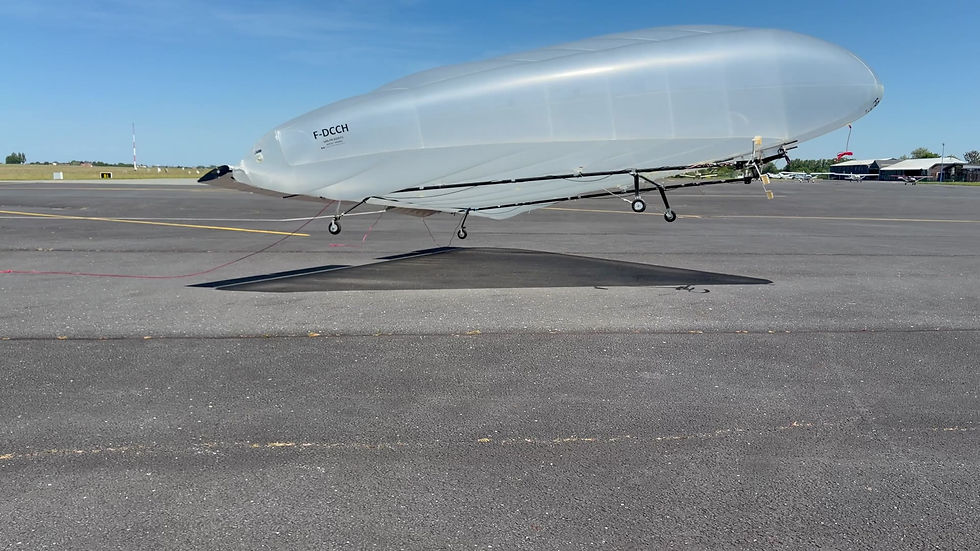
Coated textile, welded at high frequency, inflated with ambient air: the dAS20's wing carries the aircraft with a fraction of the mass of a conventional structure. No lifting gas to buy, store or lose, and an eight-meter span that folds into a bag.
Air, not helium. Pressure gives the wing its shape and stiffness. The structure is textile, the lift is aerodynamic.
Electric by design. Low mass makes battery flight viable. No fuel to carry, store or handle in the field.
Folds, travels, deploys. Wing folding is already demonstrated. The full system is designed to fit in a car.


Inflated
Folded in its bag
Disassembled kit


02 — Flight
7 May 2026
First takeoff, Le Havre airport. Built in six months by two founders.
10+
takeoffs and first short flights since
~3 months
to obtain the flight-test authorization
TRL 5
next: controlled, repeatable flight and endurance
03 — Missions
Stay back. See far. Stay connected.
The dAS20 is built for stand-off surveillance and communications relay: it holds position behind the line, observes with radar or EO/IR sensors, and bridges units, drones and ground robots where terrain blocks a direct link. Defense and security first; inbound demand already extends to maritime, energy, infrastructure and environmental monitoring.

Persistence comes from the fleet, not from a single aircraft.
Sizing scenario: six aircraft on two bases about 100 km apart, rotating for continuous coverage.
Based on target endurance and turnaround time.


MISSION CONCEPT
Linear infrastructure
Railways, power lines, pipelines and perimeters over long distances.
MISSION CONCEPT
Borders and coastlines
Wide-area observation, tracking and support to authorities.
MISSION CONCEPT
Wildfire detection
Confirm alerts fast where fixed cameras cannot see.
MISSION CONCEPT
Urgent logistics
Critical parts to industrial and offshore sites.
04 — Signal
The market came to us before we built a sales team.
30+
organizations contacted us, unprompted
14
countries
2
signed letters of intent — ROAV7 and Lux Avia Services
1
proof-of-concept under discussion with a major aerospace and defense group
"French startup flies cargo drone with an inflatable wing"
Defence Blog, 26 May 2026
"French firm's 'flying marshmallow' drone to boost aerial logistics safety"
Interesting Engineering, 14 May 2026
"Le drone gonflable de Celeste Ecoflyers intrigue la défense"
OpexNews, 18 May 2026
Also in
05 — Company
Two founders. One hard problem each.

Olivier Manette
CEO — autopilot and embedded AI
PhD in computational neuroscience, licensed ULM flight instructor. Ten years as founder-CEO of Flod.ai, a deeptech company building sensors and AI for infrastructure monitoring (Techstars, EDF Pulse).
Benjamin Degasne
CTO — inflatable wing and industrialization
Textile engineer (ENSAIT), twenty years in pneumatic structures: 50+ innovations, 10+ products industrialized, 4 patents, projects for Airbus, GE, LVMH, Hutchinson and Stellantis. CES Innovation Award 2026.
Backed, supported and supplied by
IAI × Starburst — ASTRA 2025
Impact Builders 2026
Today — TRL 4 — First takeoffs. 10+ since May 2026.
Next — TRL 5 — Controlled, repeatable flight and endurance. First paid proofs of concept.
Then — TRL 6 — Full mission with a customer payload.
After — Programs — First paid programs. Series A.
Investors
€1M
Seed round, equity, open now.
Complemented by €1.5M in targeted non-dilutive funding. The round takes the dAS20 from prototype to a customer-ready system.
Flight control: autopilot, repeatable flight
Flight testing: endurance and wind envelope
Payload integration up to 20 kg
Production and quality for a first series
Patents and three key engineering hires
Questions we get
How long can it stay up?
The first dAS20 targets multi-hour flights. Later models on the same technology target multi-day endurance, with solar assistance. Meanwhile, a small fleet in rotation gives continuous coverage.
What are the key figures?
8 m wingspan and 60 kg measured on the current prototype, batteries included, customer payload excluded. Design targets: up to 20 kg of payload and multi-hour endurance, 100% electric.
Who are your first customers?
Defense and security: stand-off surveillance and communications relay. Inbound demand already extends to maritime, energy, infrastructure and environmental monitoring.
How do you operate in European airspace?
In the EASA Specific category, with an authorization and SORA risk assessment per mission scenario. Our first flight-test authorization came in about three months, with support from ONERA and DSAC.